

The Customs Union Agreement, which constitutes a significant turning point in the economic relations between Türkiye and the EU, awaits the completion of the modernization process within the framework of today’s needs and problems.
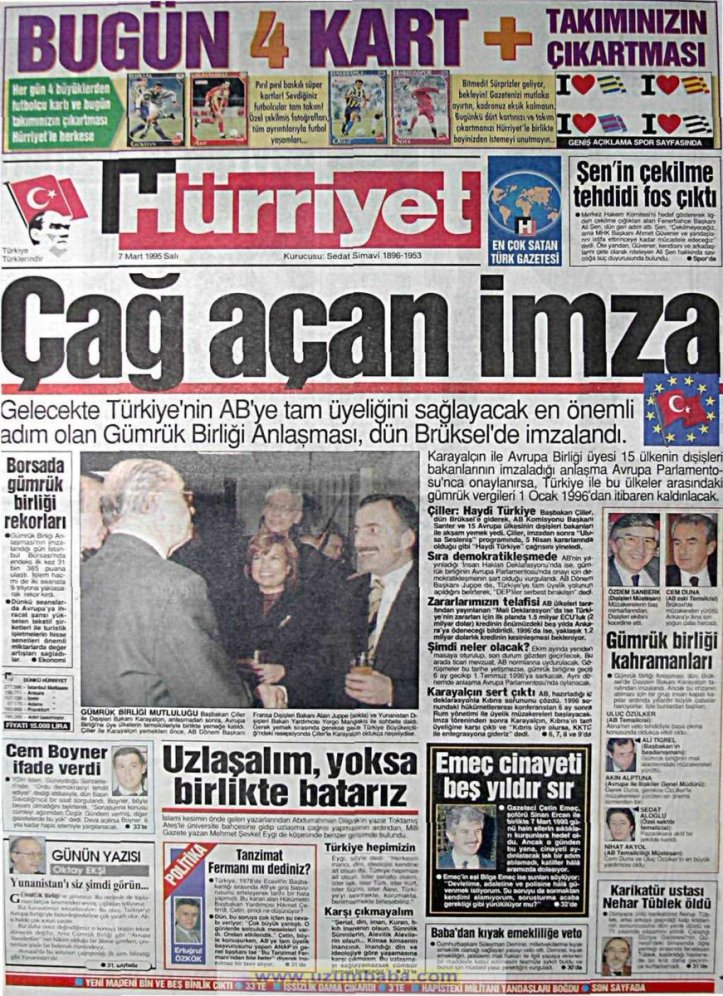
The Customs Union (CU) Agreement, which was given headlines in the Turkish press as the “era-opening signature” on March 7, 1995, has conditions that are contrary to Türkiye’s interests under the changing and developing economic conditions and put Türkiye at a disadvantage in trade relations.
Before discussing Türkiye’s CU process and its challenges, it’s helpful to define this structure. A CU means that goods from the countries participating in the agreement can circulate freely within a single customs area, exempt from all tariffs and equivalent duties, and that the parties apply the same tariff rates and trade policies to imports from third countries. Because the same trade policies are adopted for third countries, a customs union is a more advanced model of trade integration than a free trade area.
Completion Process of the Customs Union and the Goal of Full Membership
The Ankara Agreement, signed in 1963 and entering into force in 1964, set Türkiye’s full membership in the European Union—then known as the European Community (EC)—as its ultimate goal. This agreement planned the full membership process in three phases: a “preparatory period,” a “transitional period,” and a “final period.” The goal was to complete the CU after the transition period.
As part of the CU’s establishment, the EU unilaterally eliminated tariffs on industrial goods covered by the CU in favor of Türkiye in 1971. To allow Türkiye to implement the same policy, it adopted a 22-year gradual transition period starting in 1973.
From the 1980s onward, Türkiye, which abandoned import substitution policies and adopted a strategy of opening up to the outside world, adopted a more positive approach towards the CU. Türkiye, which applied for membership in the EC in 1987, accelerated the customs duty harmonization and reduction schedule, which had been postponed, and reinstated it in 1988. While the completion of the CU process is expected to ensure both financial cooperation and support for political cooperation between Türkiye and the EU, the prevailing understanding is that this process will be an effective tool not only in the commercial arena but also in the political arena.
As stated in the information note of the Turkish Ministry of Foreign Affairs, the CU was completed as of January 1, 1996, not with an agreement, but in accordance with the Association Council Decision No. 1/95 adopted at the meeting of the Türkiye-EU Association Council on March 6, 1995.
Scope of the Customs Union
The CU covers only industrial and processed agricultural products, while traditional agricultural products are excluded. There are two main reasons for excluding traditional agricultural products. First, the high share of agricultural products in Türkiye’s exports at the time, and second, the EU’s desire to protect the interests of its member states within the framework of agricultural policies.
Table 1. European Union Goods Trade with Türkiye (Billion Euros)
| Total | 2010 | 2011 | 2012 | 2013 | 2014 | 2015 | 2016 | 2017 | 2018 | 2019 | 2020 |
| Export | 58.3 | 68,9 | 71,3 | 72,6 | 70,2 | 74,1 | 72,4 | 76,7 | 69,2 | 68,3 | 69,9 |
| Import | 37,7 | 42,7 | 41,9 | 44,1 | 46,8 | 52,1 | 55,8 | 61,4 | 66,9 | 69,8 | 62,6 |
| Balance | 20,6 | 26,2 | 29,4 | 28,5 | 23,4 | 22,0 | 16,7 | 15,3 | 2,3 | -1,5 | 7,3 |
Customs Union Updating Process
Global economic developments, changes in Türkiye-EU trade relations, and the evolution of regional trade integration processes have necessitated updating the CU, which has been in effect for approximately 25 years.
The first step in addressing this need was the establishment of a High-Level Officials Working Group between Türkiye and the EU, following ministerial-level talks that began in 2014, to examine the conditions for developing and deepening the CU. Within the scope of the CU improvement process, the following initiatives were undertaken:
- Issues such as Türkiye’s simultaneous access to EU free trade agreements,
- Development of joint decision-making processes,
- Establishing mechanisms for resolving disputes,
- Mutual legislative notification and the establishment of technical regulations,
- Ensuring closer cooperation in intellectual property rights and customs,
- Trade policy measures are expected to be addressed.
Regarding the development of bilateral trade relations, negotiations are aimed at mutual liberalization in services, public procurement, and agriculture.
Public negotiations are expected to begin after the parties complete their internal consultation and approval processes. Accordingly, on December 21, 2016, the European Commission requested the EU Council’s authorization to initiate negotiations on updating the CU.
The decision adopted by the EU General Affairs Council on June 26, 2018, noted that no additional work is envisaged at this stage regarding the updating of the Customs Union.
Finally, at the 37th meeting of the European Commission-Türkiye Customs Union Joint Committee, held via video conference, the topics covered included the modernization process of the CU, trade with the Greek Cypriot Administration of Southern Cyprus, the implementation and support of the Customs Union, trade barriers, trade defense, the European Green Deal, including the EU Carbon Border Adjustment Mechanism, bilateral and transit road quotas and fees, difficulties faced by Turkish businesspeople and truck drivers in obtaining visas due to COVID-19 travel restrictions, customs issues, rules of origin, technical legislation, and agricultural trade issues and barriers.
Considering the COVID-19 pandemic, it appears that only in 2019 did Türkiye achieve a surplus in goods trade with the EU over the past 10 years (see Table 1). While Türkiye increased its exports during this period, diversification restrictions in goods trade and the reluctance of some countries with which the EU has signed FTAs to sign similar agreements with Türkiye, driven by the advantage of accessing the EU market, and the risk of trade diversion and unfair competition, persist. As stated at the last committee meeting, the technical, artificial problems created by road quotas imposed on commercial vehicles registered in Türkiye by some member states and visas imposed on businesspeople and truck drivers have made it necessary for the EU, Türkiye’s largest export partner, to update the CU with a candidate country. Given the extraordinary circumstances, resolving these technical issues and obstacles and injecting dynamism into bilateral trade could provide an opportunity for the Turkish economy, which has been going through a challenging period, to recover from a macroeconomic standpoint, particularly in the short to medium term.
Useful Resources
37th Meeting EC-Turkey Custom Union Joint Committee
European Union, Trade in Goods with Turkey
AB Başkanlığı – Gümrük Birliği
T.C. Ticaret Bakanlığı – Gümrük Birliği
AB ile Türkiye Arasındaki Ticareti Desteklemek
 journoeurope.com