

Trump’s decisive victory in the U.S. presidential election ushers in a new chapter of trade wars.
After coming to power, the new protectionist measures initiated by Donald Trump to protect its foreign trade with the slogan “America First” turned into a trade war with China in 2017. The Trump administration has adopted non-tariff safeguards at 25% and 10% on steel and aluminum imports respectively, after March 23, 2018. The effective date of the tariff increase for the EU has been postponed until 1 June 2018. Although the USA qualifies these measures as protective, it has commercial protection. The USA did not notify the WTO Safeguards Committee about its decision to implement safeguards under Article 12.1 (c) (World Trade Organization, 2018).
The US’ largest trading partners are the EU, China, Canada and Mexico. However, the USA has had a trade deficit against these countries over the years. The total trade deficit given to these countries by the USA has materialized over 500 billion dollars in the last few years.
Table 1. The US’s Most Export and Import Countries by Years (Billion Dollars)
| Years | 2017 | 2018 | 2019 | 2020 | ||||
| Countries | Export | Import | Export | Import | Export | Import | Export | Import |
| EU | 283.290,6 | 434,865,7 | 318.407,7 | 486.934,8 | 336.725,8 | 515.208,2 | 199.120,5 | 343.825 |
| China | 129.997,2 | 505.165,1 | 120.289,3 | 539.243,1 | 106.447,3 | 451.651,4 | 95.823,7 | 348.717,6 |
| Canada | 282.773,8 | 299.065,4 | 299.731,7 | 318.521,3 | 292.633 | 319.427,8 | 210.004 | 221.554,1 |
| Mexico | 243.609 | 312.666,7 | 265.945 | 344.272 | 256.570,2 | 357,970,8 | 173.741,8 | 265.935 |
| Total | 939.670,6 | 1.551.762,9 | 1.004.373,7 | 1.688.971,2 | 992.376,3 | 1.644.258,2 | 678.690 | 1.180.031,7 |
| Difference | -612.092,1 | -684.597,5 | -651.881,9 | -501.341,7 | ||||
Resource: United States Census Bureau, “U.S. Trade in Goods by Country”, https://www.census.gov/foreign-trade/balance/index.html, 2020.
There are different dynamics under the Trump administration’s launch of a trade war against China and other countries. Apart from a deficit of more than 500 billion dollars every year, there are important dynamics affecting the trade and competition process with countries. China’s applies such as dumping, discriminatory non-tariff barriers against US companies, and illegal technology transfer (intellectual property) have been an element of unfair competition between Chinese and US companies. This has led to the continuation of unfair trade practices (Parasrampuria, 2019, p. 20). The Trump administration thought that it could protect the balance in foreign trade by eliminating the unfair competition that the country faced with the trade war it would apply against China. In particular, it aimed to eliminate all new tariffs with the implementation of issues such as China’s buying more American products, opening its country to US companies, and protecting intellectual property rights (Shan, 2019, p. 99).
In addition to China, the USA has included its allies, such as the EU, Canada, and Mexico in the trade war. Steel and aluminum are among the most important resources of the automotive industry. Canada is the largest steel importer of the USA, while Mexico follows Canada. In addition, the USA gives important deficits against the EU in this regard although European automotive manufacturers have important production centers in the USA. The customs tax increases in these raw materials have been tried to be used as a tool to eliminate the disadvantage.
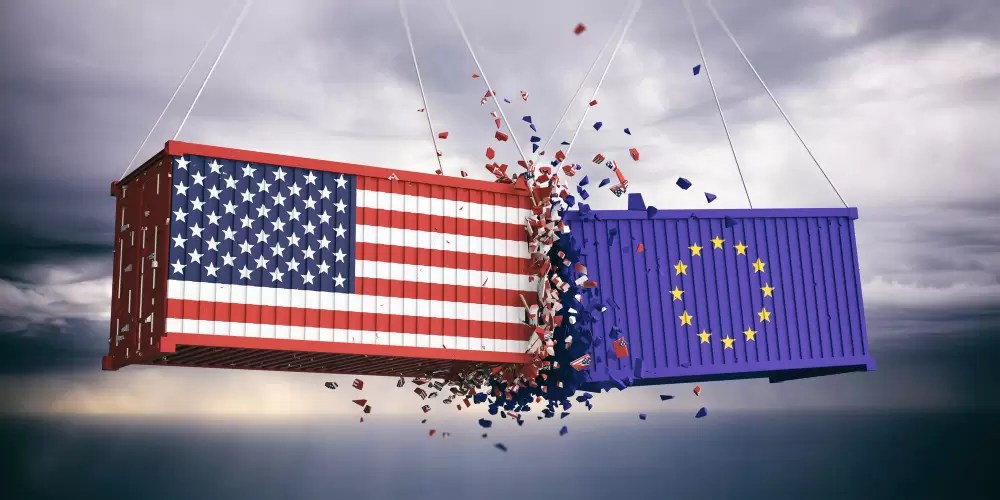
The tariff aims to increase the domestic production of the steel and aluminum sectors above 80% for the first time in many years. The US Government set the tariffs under the guise of materials vital to national defense, thereby legitimating domestic production. The real goal is to protect American industries from cheap foreign steel that is killing the domestic industry because it is highly subsidized (Parasrampuria, 2019, p. 20).
Although China is seen as a major threat to the USA in world trade, the main goal of the Trump administration is to stand stronger against its rivals in important sectors due to the priority of national policies determined before the election.
What Awaits the EU Economically in a Second Trump Term?
The sentence “War games are over. Now a trade war is coming” from the article Politico published on the subject actually summarizes the policy steps of Trump’s second term. During his campaign, Trump promised to increase the workforce in the U.S. and impose tariffs of 10% to 20% on third countries. Additionally, he threatened to impose a 60% tariff on all goods imported from China, which he positioned as an enemy.
Trump’s victory reminds EU leaders of the time in 2018 when he imposed a 25% tariff on steel and a 10% tariff on aluminum, citing national security concerns. This policy significantly harmed Europe’s automotive industry. With the onset of the pandemic, European automotive manufacturers faced high-cost supply chain issues.
In this period, the EU’s increasing reliance on U.S. liquefied natural gas to meet its energy needs raises fears that Trump’s second term could be worse. Furthermore, as Russia’s war against Ukraine enters its third winter, questions about what a Trump-Putin relationship might look like post-Biden pose additional challenges for the Union’s ability to make rational decisions.
What Should the EU Pay Attention to?
The EU must carefully evaluate whether it should negotiate with the U.S. in the face of this trade war threat. While the Transatlantic Trade and Investment Partnership continued until 2016, it ended in failure after Trump’s election in 2016. Negotiating with Trump, who has considerable power behind him, could be more challenging during this period. Purchasing U.S. natural gas, agricultural products, and defense industry goods could be part of a deal with Trump.
If the EU cannot accept the unilateral concessions Trump might demand, it should clearly state that it is ready to retaliate. Internal divisions within the EU that cast doubt on its commitment to such actions would only increase the likelihood of negative outcomes.
The EU’s dilemma highlights how trade and security are inextricably linked. How can the EU maintain its trade autonomy while being so dependent on the U.S. for its defense? How can it manage trade differences with China without turning it into an adversary? One thing is certain: the EU cannot afford to fight a trade war on two fronts.
Resources
Parasrampuria, S. (2019). The Global Trade War Triggered by the United States. GNLU Journal of Law, 2.
Shan, W. (2019). The Unwinnable Trade War. Foreign Affairs, 98(6), 99-108.
World Trade Organization. (2018). Immediate Notification under Article 12.5 of the Agreement on Safeguards to the Council for Trade in Goods of Proposed Suspension of Concessions and other Obligations Referred to in Paragraph 2 of Article 8 of the Agreement on Safeguards. Switzerland: WTO. Retrieved from https://trade.ec.europa.eu/doclib/docs/2018/may/tradoc_156909.pdf
 journoeurope.com